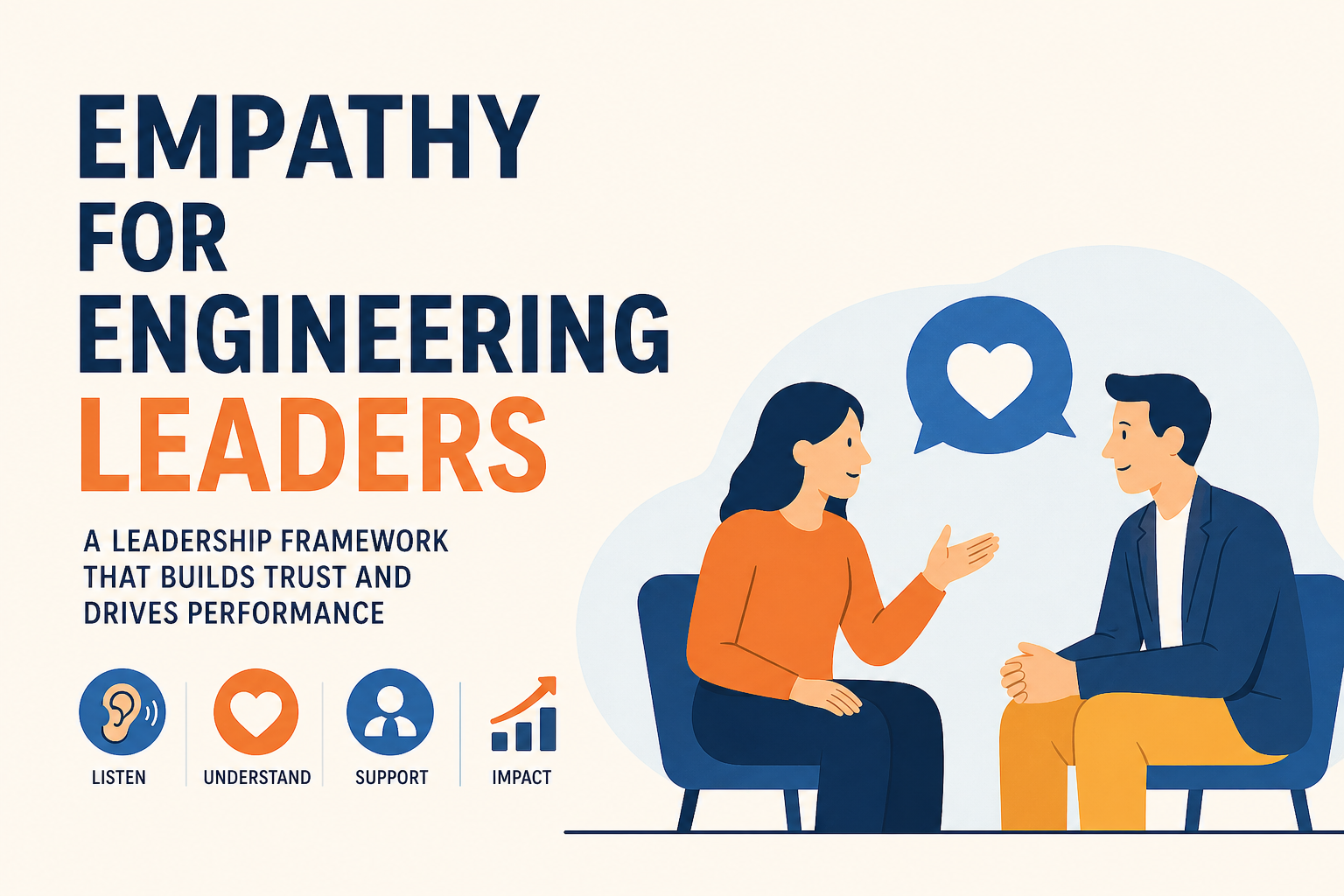
Empathy for Engineering Leaders: Building Trust and Performance

I have been trying to understand empathy without turning it into a vague instruction to “be nicer.” That advice is not very helpful when a deadline is unrealistic, an engineer is underperforming, or two people strongly disagree about a technical decision.
Empathy is not being soft.
It is not lowering standards.
It is not avoiding hard conversations.
For me, the simplest definition is this:
Empathy is understanding someone’s perspective and responding in a way that improves both performance and trust.
That second part matters. Saying “I understand” and then changing nothing may create a pleasant moment, but it is not much help. Sometimes the right response is support; sometimes it is a clearer boundary or an honest message the other person will not enjoy hearing.
I want to make the idea observable:
- what empathy is and what it is not,
- how it shows up in engineering teams,
- why it improves trust, psychological safety, and long-term performance.
What Empathy for Engineering Leaders Means in Practice
Engineering work creates a very specific kind of pressure.
- There is complexity.
- There is invisible work.
- There is cognitive overload.
- There is constant change.
- There are deadlines, dependencies, incidents, technical debt, and sometimes unclear expectations.
Because of that, empathy in engineering teams has to show up through behavior.
The first behavior is active listening.
This means full attention. No multitasking. No checking Slack during a 1:1. No preparing your answer while the other person is still speaking. Engineers often need time to explain context, constraints, trade-offs, and the real problem behind the visible problem. If we interrupt too early, we may solve the wrong thing.
The second behavior is validation.
Validation does not mean agreement. This is important. You can validate someone’s experience without agreeing with every conclusion. Saying, “I can see why that was frustrating” does not mean, “You are right about everything.” It means, “I heard you, and I understand why this situation affected you.”
That small difference reduces defensiveness. And when defensiveness goes down, problem solving becomes possible again.
The third behavior is reflective responding.
This can be as simple as saying, “Let me check if I understood you correctly…” or “So what I am hearing is…” This technique is connected with the work of Carl Rogers, but it is also very useful in engineering leadership. Many conflicts in teams are not caused by bad intentions. They are caused by misalignment, assumptions, or people using the same words with different meanings.
Reflective responding slows the conversation down for a moment, but it often saves a lot of time later.
The fourth behavior is perspective-taking.
As leaders, we see one part of the system. Engineers see another part. Product sees another. Stakeholders see another. Empathy asks us to deliberately look from the engineer’s side:
- What pressure are they under?
- What information do they have?
- What constraints are they trying to manage?
- What risk do they see that I may be missing?
This is especially useful when someone disagrees with us. A disagreement is not always resistance. Sometimes it is a signal.
The fifth behavior is problem-solving support.
Empathy does not stop at understanding. It continues with action:
- removing obstacles,
- clarifying priorities,
- reducing unnecessary meetings,
- helping with cross-team friction,
- adjusting scope when capacity is not realistic.
An empathetic engineering leader does not only say, “That sounds hard.” They ask, “What would make this easier to move forward?” or “What support do you need from me?”
The sixth behavior is follow-up.
This is where trust is built. If someone shares that they are overloaded, stuck, frustrated, or concerned, and we never come back to it, the message is clear: the conversation did not really matter.
But when we follow up, even with a simple question like, “How is that situation now?” we show that we remember. We show that the person matters beyond the meeting.
Why Empathy Builds Trust and Performance
Without empathy, problems go underground.
Engineers stop saying:
- “I am stuck.”
- “This deadline is unrealistic.”
- “I disagree.”
- “I need help.”
And when those signals disappear, leadership becomes blind.
The team may still look busy. Tickets may still move. Meetings may still happen. But under the surface, people can be burning out, losing trust, avoiding conflict, or making decisions without enough context.
Empathy brings those signals back into the open.
It creates safety for honest conversations. It helps leaders see friction earlier. It makes feedback easier to receive. It helps strong engineers stay engaged because they feel understood, not just measured.
This connects directly with building trust in engineering leadership and creating healthier team and project organisation. Empathy is not separate from execution. It is one of the conditions that makes execution sustainable.
For me, the practical test is straightforward: after listening, can I explain the other person’s perspective fairly—even when I disagree—and did my response address the actual problem they raised?
Empathy does not remove accountability. It improves the chance that accountability is based on context rather than assumption.
Download the One-Page Empathy Framework