Mental Models for Engineering Leadership: Choose How to Help
I do not lead the same way during a production incident and a career conversation. During the incident, the team needs clear roles and coordinated action. During the career conversation, the useful response may be a question rather than an instruction.
The five labels below help me notice which mode I am using: Regulator, Multiplier, Servant Leader, Coach/Mentor, and Visionary/Strategist. They are working lenses, not a scientific taxonomy or personality types.
Quick picker: Which model fits right now?
| Situation to investigate | Lens to consider | First useful action |
|---|---|---|
| Active risk or unclear operating boundaries | Regulator | Clarify roles, constraints, and the response process |
| Capable people wait for permission | Multiplier | Transfer a bounded outcome with decision authority |
| Work is blocked by access or coordination | Servant Leader | Remove the obstacle or get the right people together |
| Someone needs practice or judgement | Coach / Mentor | Explore their reasoning and agree on support |
| The team cannot explain why work matters | Visionary / Strategist | Clarify the outcome, options, and trade-offs |
These are prompts to investigate, not diagnoses. Low morale, for example, could reflect overload, unclear direction, or a difficult relationship. The label alone will not tell you the cause.
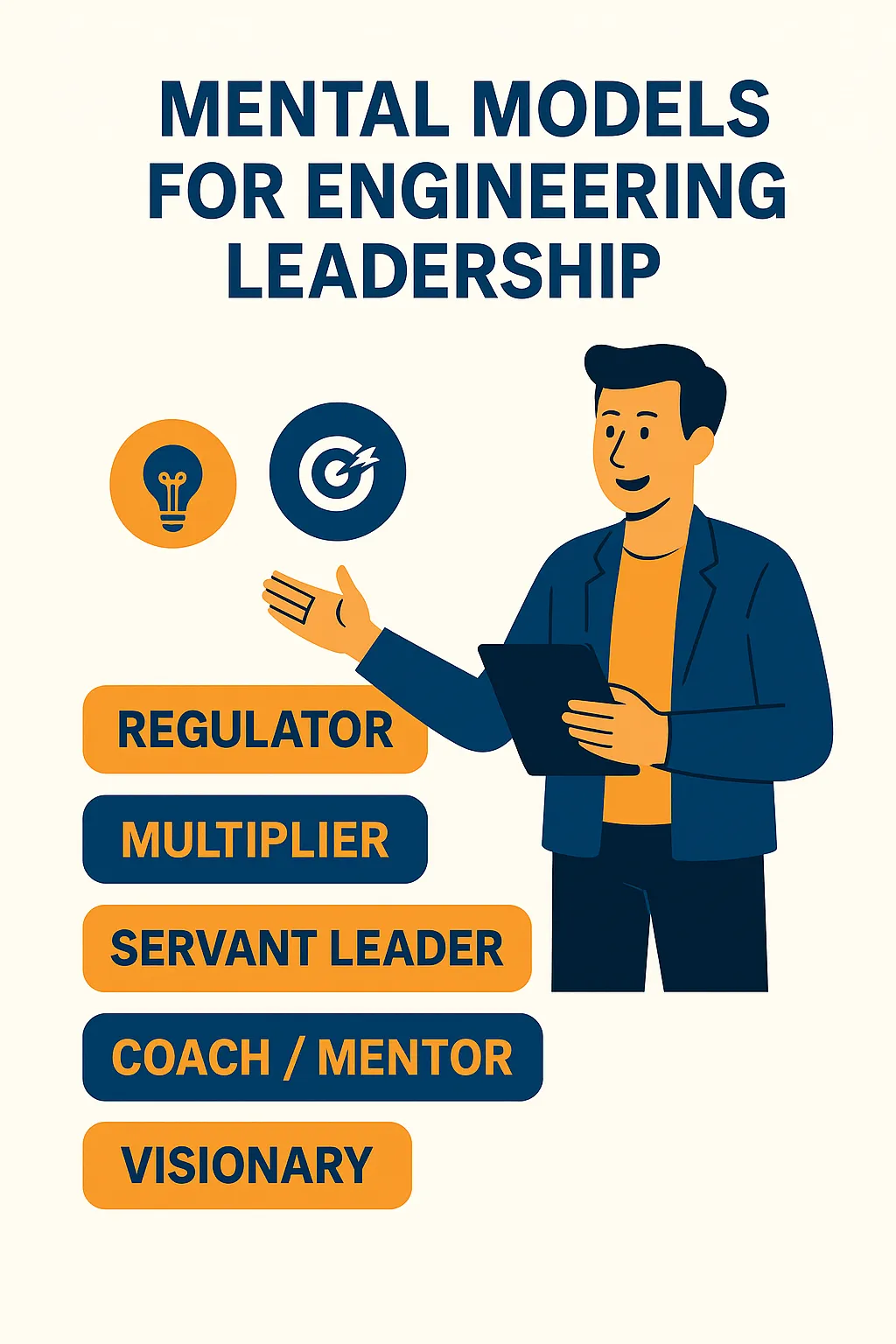
The models, in practice
The situations below are illustrative. They describe actions to try and evidence to review, not guaranteed improvements.
Regulator - stabilize and protect quality
During an incident, use the team’s response process, establish who coordinates, and make escalation criteria clear. After recovery, review which guardrails helped and which added delay.
The risk is carrying incident-style control into routine work. Explain when the exceptional constraint ends so that every ordinary decision does not keep waiting for approval.
Multiplier - amplify ownership and results
A senior engineer brings every choice about a feature back to you. Check whether you delegated only the tasks while retaining every decision. Agree on the outcome, constraints, and what they can decide independently.
Review whether ownership becomes clearer and waiting decreases. Simply assigning more work does not create autonomy. The practical starting point is delegating ownership.
Servant Leader - enable, remove friction, build safety
An engineer cannot test a change because an environment is unavailable. Help resolve the access or ownership problem. A motivational conversation is unlikely to address that particular obstacle.
Avoid becoming the permanent person who handles every dependency. Once the immediate issue is resolved, agree on a route the team can use next time.
Coach / Mentor - grow skills and judgment
An engineer is preparing their first technical proposal. Ask what decision it supports and where they are uncertain. Review the options, practise explaining the trade-off, and agree on the feedback they want afterwards.
Offer direct teaching when knowledge is missing. Coaching questions should not become a guessing game in which you already know the answer but refuse to share it.
Visionary / Strategist - clarify direction and bets
The team has three competing modernisation ideas but no shared reason to choose one. Connect each option to an outcome, a constraint, and the cost of postponing other work. Record what you will pursue and what you will defer.
A broad statement about “building a world-class platform” does not settle those choices. Use a prioritisation conversation to make them explicit.
How to use the models in practice
Before responding, ask whether the problem is missing direction, capability, authority, or a practical resource. You may need more than one response: remove an immediate obstacle, then coach the person through the next decision.
Explain the behaviour you are changing in plain language. “During the incident I coordinated the response; now I want to hear what you would change” is more useful than asking the team to memorise all five labels.
Pitfalls and fixes
If every conversation becomes coaching, people may struggle to get a direct answer. If every concern becomes a process rule, the team can lose room for judgement. If support means you personally solve every problem, dependency on you grows.
Ask the team where your response helps and where it makes work harder. That evidence matters more than which model sounds most attractive to you.
A Small Practice for the Next Month
Choose one recurring situation and note what response you used, why, and what happened next. Discuss an alternative with a peer, try it where appropriate, and ask the people involved whether it helped. Keep the exercise small enough to sustain.
Review the Choice, Not Just the Result
After a difficult meeting, ask: “What did the situation need?” and “What did I actually provide?” A poor result does not always mean the choice was wrong, but a repeated mismatch is worth investigating.
If you are beginning a management role, use the first 90 days plan to put these conversations into context.