From Software Engineer to Engineering Manager: What Changes in Your Week
Moving from senior developer or software architect into engineering leadership may look like a promotion. It felt more like changing professions to me. The habits that made me useful as an engineer — taking the difficult problem, finding the answer, and delivering it myself — could now make me a bottleneck.
The change becomes concrete in your calendar. You have to decide whether to take a sprint task, unblock an engineer yourself, prepare a difficult conversation, or help Product make a trade-off. Finishing more tasks does not resolve that choice.
This article focuses on the move into Engineering Management. Tech Lead and Staff Engineer roles can also involve leadership, but their people responsibilities and expectations may differ. Agree on your own role instead of assuming every technical leader has the same job.
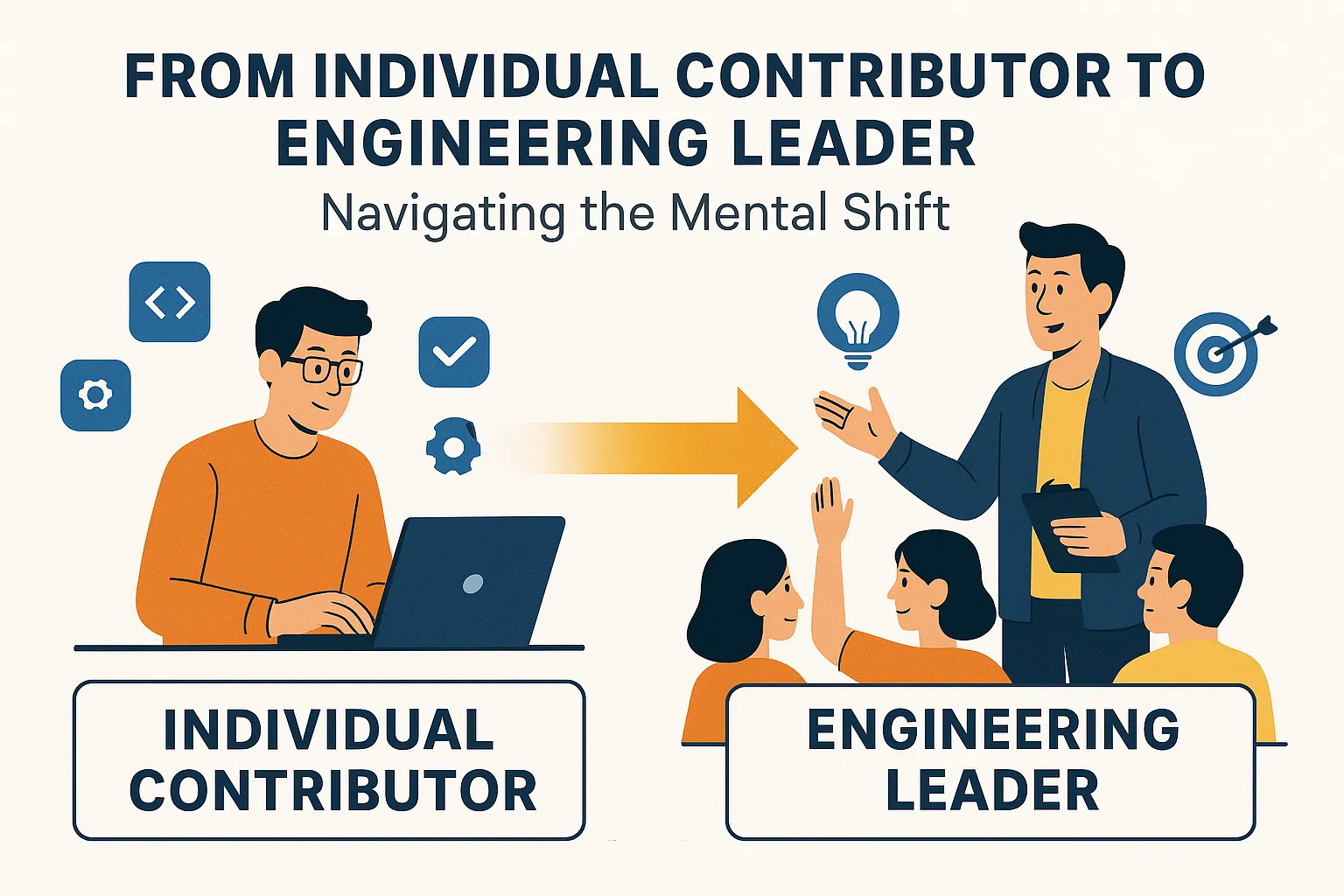
Letting Go of Personal Output
Imagine this illustrative Monday: the sprint is full, a developer is blocked, and you have two 1:1s to prepare. There is also an implementation task you know you could finish quickly.
Before taking it, ask what would happen if you were interrupted halfway through. Would the release now depend on your coding time? Would somebody else’s development opportunity disappear? Which management commitment would you postpone?
You may still choose to code. A bounded fix or a pairing session can be useful. The problem is treating your availability as predictable engineering capacity while also accepting an unpredictable management workload.
Agree with your manager and team on the technical work you will own, how much uninterrupted time it needs, and who can continue it if another responsibility takes priority.
What Changes in an Ordinary Week
| Situation | A useful management response |
|---|---|
| An engineer is blocked | Find out whether they need technical help, a decision, access, or a dependency removed |
| Product adds an urgent request | Make the displaced commitment visible and agree on the trade-off |
| Two engineers disagree in review | Clarify the decision criteria and owner before choosing a solution yourself |
| A 1:1 has no obvious agenda | Ask about workload, feedback, development, and commitments from the previous meeting |
| Work keeps waiting for your approval | Check whether you have actually delegated the authority to decide |
These actions may produce fewer visible code changes from you. They should produce clearer decisions and fewer avoidable dependencies for the team. Review whether that is happening rather than assuming every meeting is valuable.
Coach When Learning Is the Need
A blocked engineer does not always need you to solve the problem. Ask what they are trying to achieve, what they have tried, and where they are uncertain.
If they need practice evaluating options, discuss their reasoning. If they lack access to an environment, help resolve the access problem. Asking more coaching questions will not fix a missing permission.
During an active incident, use the established response process and give clear direction where your role requires it. You can return to learning and development in the review afterwards.
Useful support changes with the situation. The mental models for engineering leadership describe how I think about those changes.
Keep Technical Judgement in the Conversation
You do not need to choose every library to remain technically useful. You can ask what failure modes were considered, how the change will be operated, and what other teams will need to support it.
Consider a proposed migration. Instead of prescribing the architecture immediately, ask the owner to bring a recommendation, the alternatives, a rollout approach, and the cost of postponing it. Add the business or organisational context they may not have.
Then make the boundary explicit: are you advising, approving, or asking them to decide? Delegating ownership fails when those roles remain ambiguous.
Make Your Contribution Repeatable
The useful question is whether your intervention leaves the team better able to handle the next similar situation.
Writing a decision down, teaching another reviewer, clarifying an escalation route, or agreeing on priorities can reduce repeated dependence on you. Doing the work yourself every time usually leaves that dependence in place.
Choose one recurring request this week. Use the delegation framework to agree on an owner, an outcome, boundaries, and a check-in. Judge the handoff by whether the owner has what they need, not by whether they copy your preferred method.
Building Trust and Safety
People need to see what happens when they disagree with you or bring unwelcome news. If a risk update is met with irritation, a sentence about transparency in your introduction will not carry much weight.
Follow through on commitments, explain decisions you can share, and acknowledge when you have misunderstood something. Give feedback about specific behaviour and ask what you might be missing.
Those are repeated actions, not a promise of a conflict-free team. For concrete examples, see building trust in engineering leadership.
You Work for the Team Now
At the end of the week, review one decision that became clearer, one obstacle you helped remove, and one commitment you still owe somebody. Also ask what continued to wait for you and why.
This gives you a more useful view of management work than comparing your pull-request count with last month. It also keeps you accountable for whether your new activities help the team.
If you are beginning that transition now, use the first 90 days as an Engineering Manager to put these changes into a practical sequence.